
Why Your Workday Global Payroll Connect Investment Isn’t Delivering
The last mile in global payroll, and how to connect it
On this page
In brief. Workday GPC provides the framework for global payroll and delivers its value once each local payroll provider is connected. datascalehr makes that connection in under an hour per country, so you keep your payroll providers and your GPC licenses.
Executive summary
Your organization invested in Workday and licensed Global Payroll Connect (GPC) to unify global workforce data, with a single view of payroll across every country where you operate. In many organizations, payroll teams still export CSVs, reconcile spreadsheets, and manage data by hand across dozens of local payroll systems months or years after the GPC purchase.
Workday GPC provides the framework for global payroll. The remaining work is the last mile: the connection between GPC and each in-country payroll engine. In many organizations, the connection to each local payroll engine is missing, is custom built at high cost, or needs frequent repair.
datascalehr now connects GPC to local payroll engines in under an hour per country. A connection that used to require a project of up to 12 months per country and millions in cost now takes a fraction of the time and budget. You keep your payroll providers, you avoid buying overlapping software, and you add the one component that connects GPC to the local payroll engines.
The global payroll connectivity gap
Most multinational corporations face the same situation. Despite millions, and sometimes tens of millions, spent on integration projects, APIs, and consultants, payroll data management often remains manual and error prone. Traditional integration tools were designed to connect systems, and most traditional integration tools were not designed around how payroll data behaves.
Why traditional integration struggles with payroll
Payroll data differs from other enterprise data in three ways. Payroll data is transient, because tax laws, regulations, and company policies change constantly. Payroll data is parochial, because the data is specific to each country, region, and even industry. Payroll data is idiosyncratic, because the data reflects each organization’s own practices and systems. Traditional integration moves payroll data as static records, and payroll data has to be understood and transformed on the way.
Static, rule-based integrations start to degrade from the day the integrations are built. Every format change, regulatory update, or edge case requires costly reconfiguration. Enterprises average 15 errors per payroll period, each costing $291 to fix. Payroll teams spend 40 to 60% of their capacity on manual data management.
The connection between Workday GPC and local payroll
Workday is strong in core HR, and Global Payroll Connect provides the framework for global payroll visibility. GPC works through partners that move data between local payroll vendors and Workday. To get value from GPC, each local payroll provider needs a connection to GPC: ADP in the UK, Datev in Germany, SD Worx in Belgium, SAP in Australia, and dozens more.
Building those connections the traditional way means a custom development project for each country (6 to 12 months for a complex country, 3 to 6 months for a medium one, and 1 to 3 months for a small, simple one, with at least half of the time and effort going to data cleanup, mapping, testing, and parallel-run reconciliation), ongoing maintenance as local providers change formats, separate reconciliation processes, and continuing consultant fees. For a company operating in more than 30 countries, the traditional approach means millions in implementation costs and years of work.
Three options for connecting GPC
Organizations usually consider three paths to connect GPC to local payroll:
Option 1: Move to Workday-certified global payroll providers
Benefits:
- Single-point integration with Workday.
- Single vendor relationship for support.
- Workday-certified integration.
Downsides:
- Re-implementing payroll in every country takes 2 to 3 years and costs millions.
- Migration disrupts operations and adds compliance risk.
- Established local providers that may be performing well have to be replaced.
Option 2: Buy payroll consolidation overlay software
Benefits:
- Keep existing local payroll providers.
- Provides global dashboard and reporting.
- Faster than full re-implementation.
Downsides:
- Adds cost on top of existing GPC licenses.
- Requires readiness to trust AI-driven data transformation in place of traditional coding.
- A proven solution from a vendor that is still in its growth phase.
Option 3: Add the connector layer with datascalehr
Benefits:
- Keep all existing local payroll providers.
- Uses the GPC licenses you already hold, with no overlapping software. Setup takes under an hour per country.
- datascalehr’s deterministic algorithms handle 91% of cases, covering mapping, validation, and transformation, and payroll specialists confirm the rest.
Downsides:
- Adds cost on top of existing GPC licenses.
- Requires readiness to trust AI-driven data transformation in place of traditional coding.
- A proven solution from a vendor that is still in its growth phase.
Option 3 keeps your investments in both Workday and your local payroll providers, and delivers the global visibility that GPC is designed to provide.
The solution
Adding the connector layer
An AI-native integration layer
datascalehr started from the idea that an integration system could learn. Instead of hard-coding transformation rules for every provider and format, the datascalehr team built an AI-native integration layer that understands payroll data and adapts as provider formats change.
KMod™ is datascalehr’s AI-powered knowledge model for HR and payroll data. KMod™ learns from the decisions of payroll experts who confirm or reject KMod™’s mapping suggestions, and KMod™ never stores personal data or data values. When KMod™ reads a local payroll provider’s file, in any format, structure, or language, KMod™ predicts what each field means and how each field should be transformed for GPC. datascalehr’s deterministic algorithms handle 91% of cases, covering mapping, validation, and transformation, and the approach is predictive, not generative.
Workday GPC enabler
Workday built the GPC framework, and the datascalehr Workday Global Payroll Connect Enabler makes the GPC framework work with all your payrolls. KMod™ connects GPC to local payroll providers worldwide and handles field mapping, format conversion, and validation for each country. When local requirements change, the GPC connection adapts without reconfiguration.
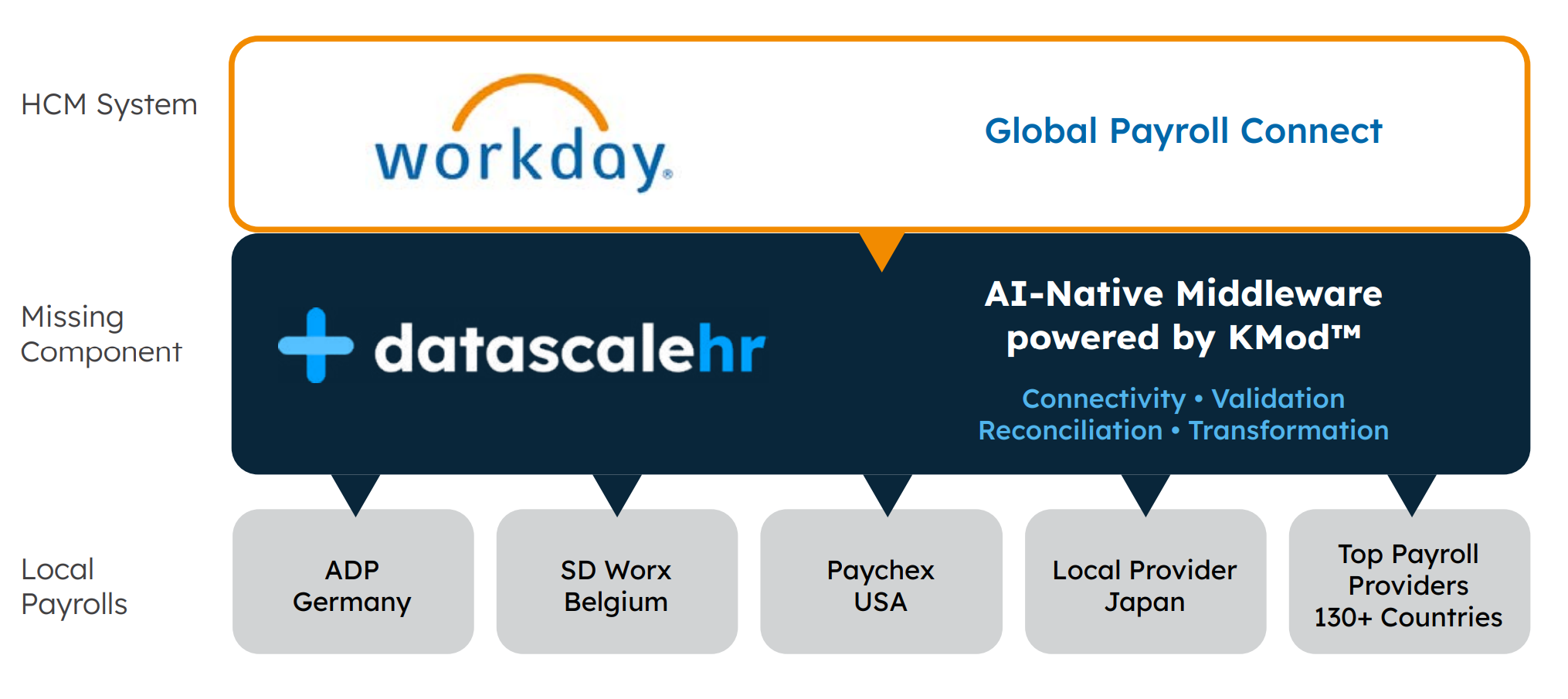
You keep your existing local payroll providers and the GPC licenses you have already purchased.
datascalehr adds the integration layer that connects your GPC licenses to your local payroll providers.
Setup takes under an hour per country. KMod™ keeps learning from expert-confirmed decisions as providers change their formats, which reduces maintenance.
Mapping accuracy improves as payroll experts confirm more decisions, so a datascalehr integration gets better over time instead of degrading.
Results on datascalehr’s platform
handled by deterministic algorithms, predictive, not generative
with real-time visibility, built-in reconciliation, and audit trails
at Europe’s #1 payroll provider
Next steps
If you hold Workday GPC licenses and have not yet seen the value you expected, the next step is straightforward. You do not need to re-implement payroll or buy overlay software. Add the connector layer that links GPC to your local payroll providers.
For CHROs and Heads of Global Payroll: Get the unified global workforce view that GPC is designed to provide, without disrupting established local payroll operations.
For CFOs: Protect existing Workday and local payroll investments. Connect each country to GPC in under an hour.
For CIOs and IT: Avoid overlapping software purchases and custom integration projects that need ongoing budget.
Talk to us about your payroll landscape
Tell us which HR system and payroll providers you run, and datascalehr will show how the connections work on your own data.
Request a meeting