
KMod™ and the Context Layer
KMod™ understands your payroll data.
KMod™ is datascalehr’s knowledge model for payroll data, an AI trained on 2M+ validated mapping decisions across 180 countries. Every country runs payroll its own way, in its own systems and formats. KMod™ takes your data exactly as it is, so you don’t need to reformat it, fill in templates or clean it up first. KMod™ keeps every detail and reshapes the data to fit whatever system or app needs it next.
- WWorkday
- SSAP
- AADP
- DDayforce
- OOracle
- FFiles and spreadsheets
- ++ any system
- 1Read any fileInbound and outbound
- 2Understand payrollKMod
- 3Validate up frontAt the source
- 4Learn to connectIntegration agent
MasterData↔Basic InfoStructures discoveredOT_HRS_WKField read and typedEE_BASE_SAL_AMT→BaseSalaryPredicted and confirmed by a humanCOST_CTR_CD→CostCentreValidated at the sourceTAX_ST_CODE→StateTaxJurisdictionAdjusted once, rule learned
EE_BASE_SAL_AMT→BaseSalarySent to the targetValue 4,200.00 → 4,350.00COST_CTR_CD→CostCentreSent to the targetValue CC-100 → CC-1040StateTaxJurisdiction→TAX_ST_CODEReturned to the sourceValue US-NY → NY
- PPayroll providers
- LLocal payroll engines
- HHR systems
- FFiles in each provider’s format
- GGeneral ledger and banks
- ++ any system
In production
Faster reconciliation
Europe’s #1 payroll provider cut reconciliation time from 4 hours to 15 minutes per cycle.
Developers required
Your payroll team runs KMod™ itself, without engineers, an IT project or a wait in the ticket queue.
To connect a country
After one day of training, each country takes less than an hour. Your specialist uploads a file, checks the matches and confirms them.
KMod™
The learning engine that turns payroll chaos into clean, usable data.
KMod™ only picks from matches it already knows are correct, so when it knows the answer, it is right every time. When it isn’t sure, it flags the match for a person to check instead of making something up the way a chatbot would. Across a typical file, KMod™ takes 89% of the work off your team.
KMod™ is built on 30 years of payroll know-how and the patterns from 8,000+ file types across 180 countries. When anyone fixes a match, every other user gets the better result a minute later.
Four knowledge categories
KMod™ learns and keeps getting better.
File shape
It knows how any file is built.
KMod™ has learned from 8,000+ formats to recognize how a file is laid out, what each column means and how the pieces fit together. It has seen exports from Workday, SAP, ADP and most other major HR systems, so when a new file arrives, it already knows what it’s looking at.
Local rules
It knows each country’s payroll vocabulary.
Germany, Brazil and the UK each calculate pay, tax and benefits their own way. KMod™ knows those differences, understands how they relate and handles the data correctly for all 180 countries.
Every decision
2M+ decisions, with more every day.
KMod™ records each mapping choice, correction and validation the moment a user makes it. A competitor starting today would need years of live deployments to build the same history. When your specialist in Munich corrects a mapping at 9:00 AM, a colleague in Vienna benefits at 9:01 AM.
The meaning of pay codes
Classification that improves with use.
KMod™ maps, transforms and validates pay components, deduction types, tax codes and employer contributions across countries. That classification is what makes cross-country comparison possible, and it gets more precise with every deployment.
Architecture
How KMod™ is built differently
It preserves every detail and every change.
KMod™ keeps your data exactly as it arrives, with every local pay code and detail intact, and reshapes it to fit whatever you need. Because nothing is dropped, you can reshape the same data a different way later.
It predicts from known answers
KMod™ picks from matches it already knows are correct, so it doesn’t make things up. 89% of the matches are right before anyone checks them. For the remaining 11%, KMod™ offers clearly labelled suggestions that a specialist confirms in a few minutes.
It reads and writes
KMod™ reads from your systems and writes back to them, from your HR system to your payroll provider and back, applying each country’s rules in both directions.
Managed by the team that knows best
Payroll specialists and HR administrators build the connectors themselves and make the mapping decisions where the knowledge sits. Nothing waits in a queue for a central engineering team.
What the platform does
Payroll capabilities that work out of the box
Every capability runs on the same KMod™ engine, so once one is set up, the others can use the same data and mappings.
Connect any system to any other
Link any HR system to any payroll provider, including Workday, SAP, ADP, Oracle and Dayforce, through 1,100+ live connectors.
Payroll reconciliation
Compare any two sets of data, even when the employee IDs don’t match. See exactly what changed from one period to the next and from one system to another.
Post to your general ledger
Send payroll straight into your accounting, with the right accounts, currencies, and cost centers for each country, automatically.
Upload any file, any format
CSV, tab-delimited, XML, JSON, XLS, XLSX, PDF, GlobalView G2, Workday DCOD and SAP infotypes, delivered by SFTP or API.
Move off an old system fast
Bring over old data in any format, match it to the new setup and check every record. Run the old and new systems side by side until the numbers agree, all in a day or less.
Global payroll aggregation
Pull together and tidy up data from every local payroll system for reporting, dashboards, and pay analysis.
Smart transposition
KMod™ reads any data you upload and transposes it into a cleaner structure you can use, without templates or file specifications. It recognizes pay code structures, aggregates by employee and maps to the target format automatically.
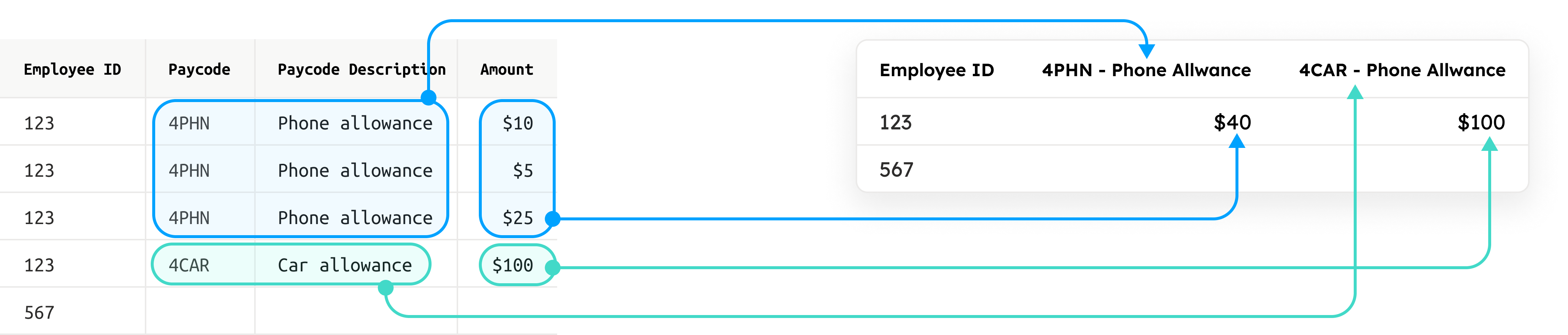

Smart aggregation
KMod™ finds duplicate and conflicting data across sources and reconciles it automatically, even when employee IDs don’t match across systems. It merges duplicate rows and flags gaps, so the output is clean and audit-ready.
The Context Layer
The foundation your AI agents are going to need.
AI agents are starting to reach into payroll and HR. The ones that work will be the ones with reliable data underneath, because an agent that reads payroll wrong is worse than no agent at all. datascalehr provides that foundation, which we call the Context Layer for global payroll data. It is one place where every system’s data is kept whole and reshaped on demand, so any app or AI agent can build on it without breaking.
A bigger shift is already under way. Companies want to build their own AI agents, on their own data and inside their own walls. Over the next decade, the advantage will go to the companies that control their data, and the Context Layer gives them that control.
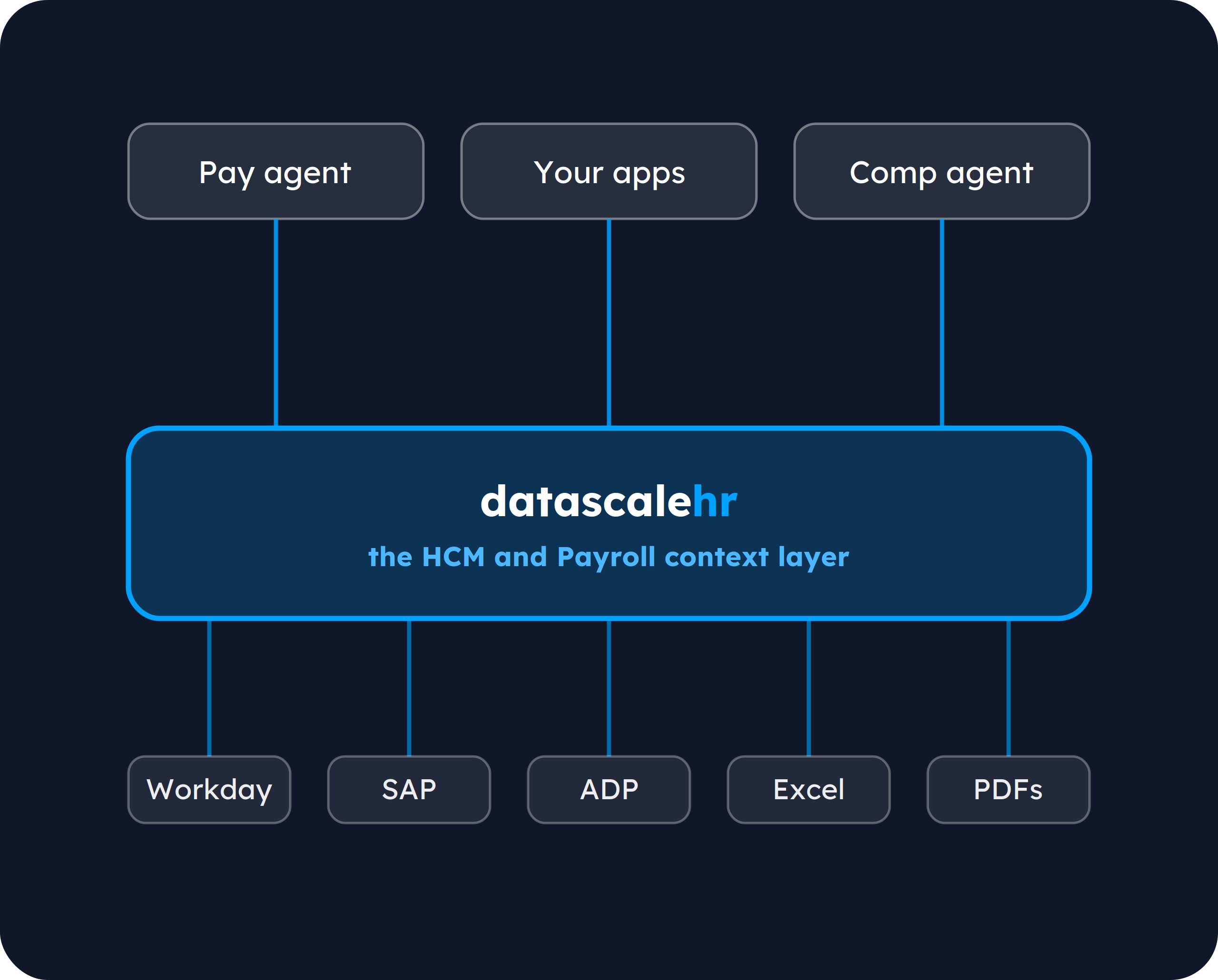
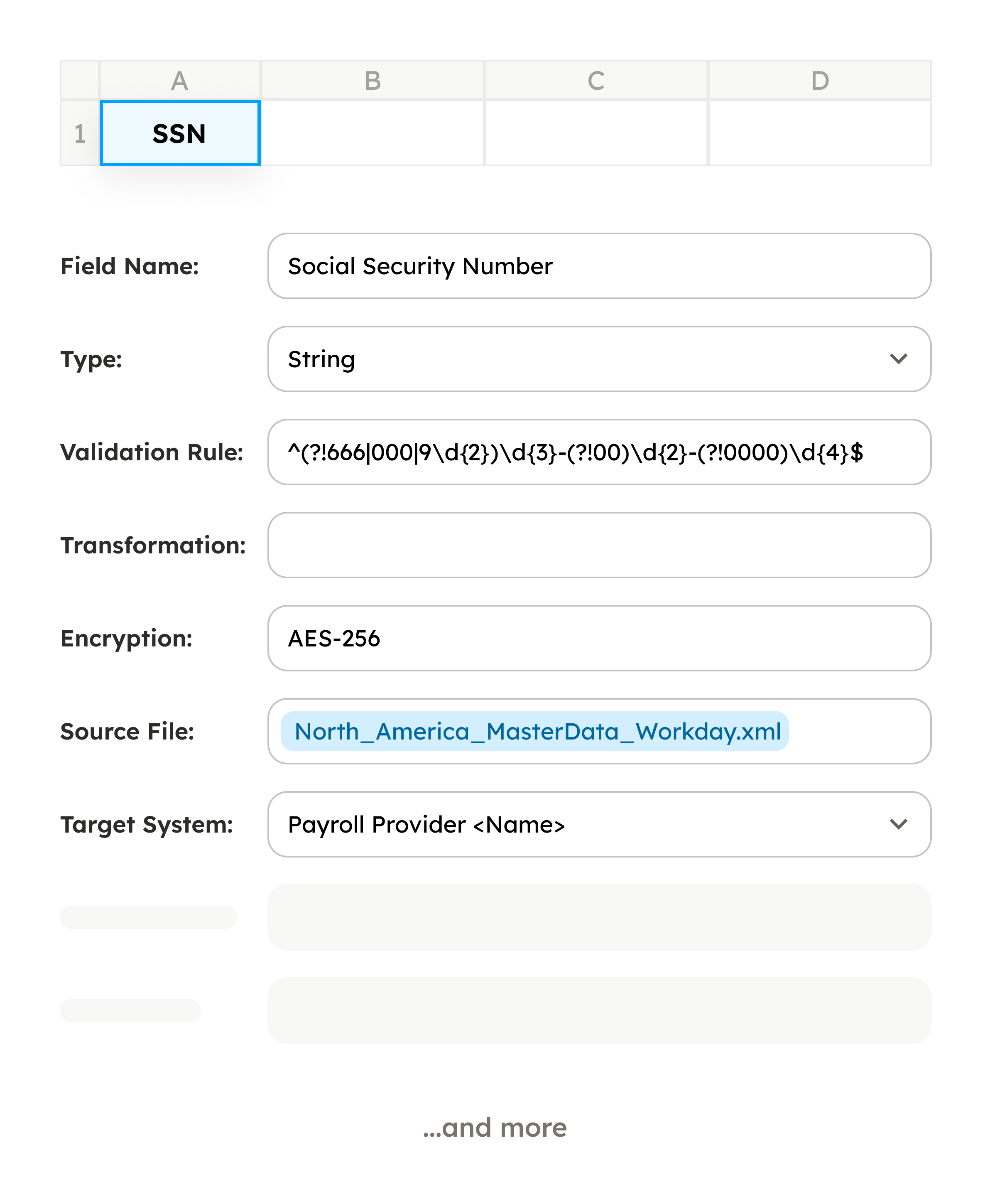
Layers of context
Field-level lineage.
datascalehr records where each field came from, where it goes and how it was validated, transformed and mapped. That audit trail supports external audits and the AI agents companies are starting to deploy. Every change to the data can be explained and traced to its origin.
Security
Secure and compliant by design.
Your own cloud
Each client runs in its own environment on Mendix Cloud, hosted on AWS in Germany and Ireland.
SOC 2 and ISO 27001
Built on a SOC 2 and ISO 27001 certified platform.
Field-level encryption
You control which data is encrypted.
Role-based security
People can only see and act on the data their role allows.
FAQ
Frequently asked questions
What is KMod™?
KMod™ is the datascalehr knowledge model for payroll data. KMod™ has learned from more than 2 million validated mapping decisions and more than 8,000 source and target schemas across 180 countries, and KMod™ maps data between any HR system and any payroll provider. KMod™ completes 89% of the mapping work.
Does KMod™ hallucinate?
No. KMod™ is predictive, not generative, and picks from matches that payroll experts have already confirmed. When KMod™ is unsure of a match, KMod™ flags the match for a person to check instead of inventing an answer.
What is the Context Layer for global payroll data?
The Context Layer is one place where every system’s payroll data is kept whole and reshaped on demand, so any application or AI agent can build on the data. datascalehr records where each field came from and how each field was validated, transformed and mapped.
Which systems can datascalehr connect?
Any HR system to any payroll provider, including Workday, SAP, ADP, Oracle and Dayforce. datascalehr reads CSV, tab-delimited, XML, JSON, XLS, XLSX, PDF, GlobalView G2, Workday DCOD and SAP infotypes, delivered by SFTP or API.
How is customer data secured?
Each client runs in its own environment with its own database on Mendix Cloud, hosted on AWS in Germany and Ireland. The Mendix platform holds SOC 2 Type II and ISO/IEC 27001 certification, and datascalehr adds role-based access and field-level encryption that you control.
