
iPaaS vs Unified API vs Custom Code vs Context Layer
How to choose a global payroll data architecture
On this page
In brief. The right architecture depends on how many countries you cover and whether data must flow back into local payroll. iPaaS tools suit single-country flows, unified APIs suit read-only work on common engines, and a context layer is built for many countries at once.
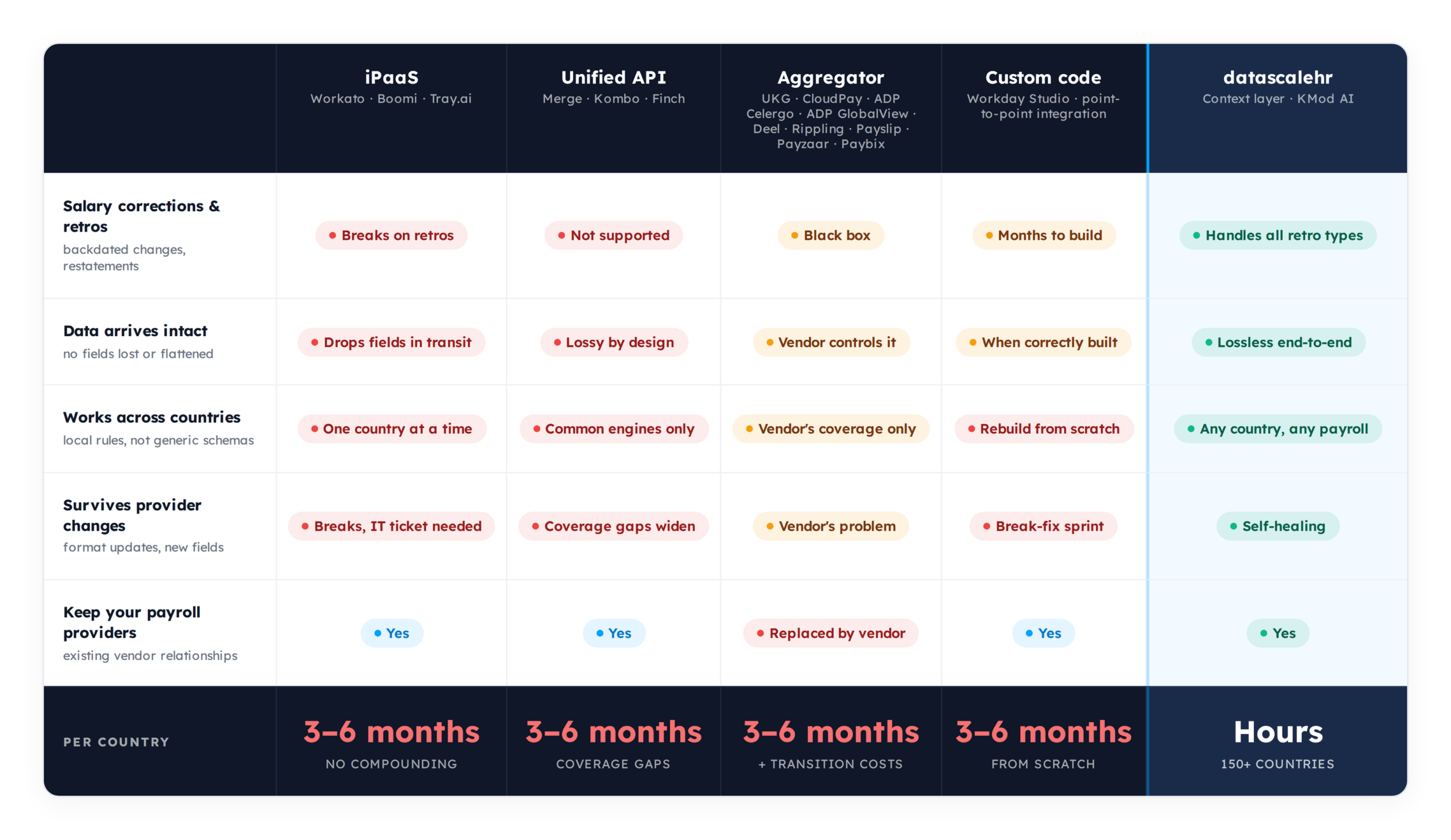
Four architectural approaches dominate global payroll integration: general-purpose iPaaS (Workato, Boomi, Tray.ai), unified APIs (Merge, Kombo, Finch, Papaya), custom code (Workday Studio, point-to-point integration), and a specialized context layer (datascalehr). Each approach fits a different problem. iPaaS is built to move any data between any systems. A unified API works for read-centric integrations against the most common engines. Custom code works for one country at a time.
A context layer is built specifically for bidirectional global payroll connectivity across many countries with full data fidelity. The four approaches differ in per-country deployment time, in what data survives the trip, and in whether the work scales.
This page compares the four approaches across the four dimensions every HR-to-payroll integration must solve: time, structure, vocabulary, and destination.
This paper is written for heads of global payroll, CHROs, CFOs, CIOs, and CTOs evaluating how to connect Workday, SAP SuccessFactors, Oracle HCM, Dayforce, or UKG to local payroll engines in multiple countries.
1. Data pipes vs. data fluid
The integration industry has spent 30 years building better pipes: better connectors, better APIs, better drag-and-drop logic, and better aggregation layers. A pipe answers one question: how does data move from System A to System B without custom code?
For HR tech startups syncing employee rosters from 200 HRIS platforms, pipes are the right answer.
Global payroll asks a different question: will the data arrive with the precision, structure, and meaning the target system requires? The payroll question is about the fluid inside the pipe. Source data carries country-specific compensation components, retroactive deltas, future-dated instructions, and statutory references. A generic canonical schema cannot compress those elements without losing fields that downstream payroll engines need to process pay correctly. The pipe can keep flowing while the payroll data inside the pipe is corrupted.
The schema problem is one example from one dimension. The next section names all four dimensions.
2. The four-dimensional problem of HR-to-payroll integration
Most integration platforms move data from System A to System B. HR-to-payroll integration moves four kinds of meaning at the same time. Each dimension has its own logic, and any one dimension can break a generic tool. Together, the four dimensions are the reason many multi-country payroll integrations slip from quarters to years.
Dimension 1: Time
HR systems and payroll engines both store data inside validity windows, but the two systems rarely agree on what time means. The HR System of Record carries effective-dated records: every personal change, compensation element, position, and payment election has a start and end date. The Target Payroll System runs against pay periods, statutory cutoffs, proration rules, and, in some countries, collective bargaining agreements that override the date stated in HR.
Solving the time dimension means handling six distinct temporal behaviors:
- Effective dating. The integration must reconcile source effective dates with target pay-period semantics, because a source value is rarely the value the target expects.
- Retrocalculations. Retros include backdated salary changes, state corrections (a hire or termination recorded on the wrong date), absence adjustments, benefits election changes, retroactive cost-center reassignments, and any other prior-period restatement. When any of these changes is recorded, the target recomputes prior periods, generates retro deltas, recalculates statutory deductions, and creates new records alongside the originals. One event in the source can produce dozens of records in the target.
- Future-dated instructions. Some changes are scheduled in advance and can be reversed, with visibility rules that vary by country and client. The right time to transmit a future-dated change depends on the receiver.
- Year-to-date assembly. Targets store results in separate tables for the current period, retros, the original calculation, tax totals, contribution totals, and YTD accumulators. Pulling a single YTD figure requires knowing which combination of tables to add together.
- Historical retrieval. Parallel runs and migrations need source data “as at” a prior date instead of “as at now.” Snapshot integrations cannot retrieve data as at a prior date.
- Multiple sync modes. A current-state sync and an effective-dated-stack sync are different products. The integration has to support both sync modes, configurable per implementation.
Generic tools move dates. A generic tool cannot decide which date wins, reconstruct prior states, or model the consequences of a retro.
Dimension 2: Structure
HR Systems of Record store data in deeply nested object graphs. Workers reference positions, and positions reference cost centers, managers, and pay groups. Properties such as manager and cost center belong to the relation between worker and job instead of to the worker directly. The Target Payroll System consumes flat tabular templates with one row per worker per pay period.
Across hundreds of source attributes spanning dozens of object types, only a fraction of the data a payroll cycle requires is stored directly on the worker. The remaining data is on related objects or peripheral relationships, or has to be derived from joins between tables.
Solving the structure dimension means restructuring data, which goes beyond field-to-field mapping. Restructuring requires:
- Worker-to-position-to-position-related-object joins
- Flattening peripheral data (manager, cost center, pay group) into worker rows
- Multi-position worker handling with cardinality-aware join logic
- Derivation rules for the inputs that are not directly available
- Hierarchy-aware change detection (a position change is not the same as a worker change)
Generic tools move fields between systems without flattening the hierarchies the fields come from.
Dimension 3: Vocabulary
Source and target rarely use the same vocabulary, even when the two systems appear to. The HR System of Record emits values from its own enumerations: relationship types, marital statuses, employment categories, compensation plans. The Target Payroll System expects values from a different list, often set per client and per country.
Solving the vocabulary dimension requires:
- Per-client, per-table, per-country enumeration dictionaries
- Handling polymorphic “type” columns that mean different things across different tables
- Separate ingestion paths for reference and lookup tables (citizenship, country, language)
- Defensive ID resolution where source IDs that should be unique are not
The vocabulary problem multiplies per client, per table, per country, per template, and per provider, so the vocabulary problem grows N-squared. The vocabulary work never finishes unless a system learns the mappings.
Dimension 4: Destination
Output format constraints reach upstream into source extraction. The Target Payroll System’s expected template determines what data has to be pulled, in what shape, and in what order. Most integration platforms ignore the destination dimension until a template constraint causes a failure.
Solving the destination dimension requires:
- Reverse-engineering source extraction from the receiver’s template requirements
- Pluggable template adapters per Target Payroll System (different receivers expect different shapes)
- Derivation rules for fields the receiving template requires but the source does not supply
- Template-aware field naming and ordering at extraction time
- Per-template handling of split assumptions (multi-account, multi-method, multi-period)
- Physical constraints (sheet name length, character rules, ordering) handled before they crash the integration
Generic tools generate output files from whatever data the tool receives. A generic tool does not work backward from the receiver’s template to decide what to extract.
Why generic tools fall short across all four dimensions
Source and target almost never agree on time, structure, vocabulary, or destination. iPaaS recipes, unified APIs, and custom code each tackle one or two of the dimensions and assume someone will patch the rest manually. The manual patches accumulate, and the integration can start producing wrong numbers in production before anyone notices, because no part of the architecture owns the missing dimension.
A context layer is built to address all four dimensions. KMod™ predicts mappings, validations, and transformations across thousands of source-target pairs. KMod™ encodes time-aware state reconstruction, hierarchical-to-flat transformation logic, vocabulary translation across many countries, and destination-driven extraction rules. The differentiator matrix after the four-approach comparison lists the full set of required capabilities.
Approach 1: general iPaaS (Workato, Boomi, Tray.ai)
iPaaS platforms are general-purpose integration tools with drag-and-drop logic, AI-assisted field mapping, and large connector libraries. iPaaS platforms move data between SaaS systems, ERPs, and databases. For payroll integration, iPaaS brings real strengths: high compatibility with legacy systems, thousands of prebuilt recipes, and IT teams that already know the tools.
For global payroll, the limits of iPaaS show up across the four dimensions.
Time: iPaaS recipes can move dates but do not reconcile effective-dated source records with target pay-period semantics. Retros, future-dated instructions, and historical “as at” retrieval all need logic that someone builds by hand for each country.
Structure: the auto-mapping function in an iPaaS tool maps strings and does not model hierarchies. Flattening a deeply nested HR object graph into a flat payroll template requires multi-step joins and derivation rules that the recipe builder must specify by hand.
Vocabulary: AI-assisted mapping handles direct value translations. A recipe library is not pre-trained on the N-squared growth of global payroll values across clients, tables, countries, and templates.
Destination: iPaaS recipes generate output but do not work backward from the receiver’s template constraints to decide what to extract. Validation logic, transformations, and derivation rules are outside the platform and have to be coded per country.
Per-country deployment on Workato or Boomi typically takes 6 to 12 months for a complex country, 3 to 6 months for a country of medium complexity, and 1 to 3 months for a small, simple country, and the work on one country does not shorten the next. Thirty countries becomes a multi-year project, and each provider format change becomes an IT ticket.
Fit: single-country payroll integration, read-centric SaaS-to-SaaS flows, and organizations with a strong in-house iPaaS practice already in place for non-payroll use cases.
Approach 2a: unified API middleware (Merge, Kombo, Finch)
A unified API abstracts hundreds of HR and payroll systems into a canonical schema, so a developer connects once and reads from any supported source. The architecture suits HR tech startups building products that consume employee data, such as recruiting tools, org chart visualization, benefits administration, and headcount analytics.
For global payroll, the unified API model has structural limits across all four dimensions, plus a coverage limit that buyers should check early.
Coverage. Unified API providers generally offer APIs for the most common payroll engines and focus on core data. The long tail of country-specific local providers, the full depth of payroll result tables, and the specialized fields needed for statutory reporting are often outside the unified API’s coverage. Buyers should confirm coverage country by country.
Time: canonical schemas usually represent a current snapshot. Canonical schemas can lag behind source systems on retros, future-dated changes, and statutory updates, and historical retrieval is generally not supported.
Structure: canonical schemas handle structure by flattening every source into a lowest-common-denominator shape. The common shape loses country-specific compensation components and statutory references that the target payroll engine requires.
Vocabulary: a unified API translates source values into a generic vocabulary, which differs from the specific values the Target Payroll System expects.
Destination: most unified APIs are optimized for reading. Write-back to local payroll, with country-specific validation and effective-dating semantics, is outside the abstraction layer.
Fit: read-centric HR tech and single-country payroll connections to common engines. The coverage limits make unified API products a poor fit for multinationals running payroll in more than a handful of countries.
Approach 2b: multi-country payroll providers and aggregators (UKG Immedis, CloudPay, ADP Celergo, ADP GlobalView, Deel, Rippling, Payslip, Payzaar, Paybix)
Multi-country payroll (MCP) providers appear often in the same evaluations as integration platforms, but MCP providers are a different category. Unified API products such as Merge and Finch are technology middleware. MCP providers are payroll service providers. Choosing an MCP provider is a sourcing decision, and choosing an integration architecture is a technology decision. A buyer can make the two decisions independently, and many buyers do.
What the MCP model offers. UKG Immedis, CloudPay, ADP Celergo, Deel, Rippling, Remote, Payslip, Payzaar, and Paybix each provide a managed global payroll service built on a network of in-country payroll partners. The client sends workforce data to the MCP platform. The MCP routes the data to local payroll engines, manages statutory compliance per country, and consolidates reporting back to the client. The client gets a single contract, a single SLA, and one escalation path in place of 20 or 30 direct relationships with local providers. For companies entering new countries quickly, or running lean payroll teams without the capacity to manage local providers directly, the simpler structure is a real operational advantage.
What the MCP model requires. The MCP model removes local-provider complexity by moving control of the payroll delivery chain to a third party. The transfer of control has consequences that belong in any honest evaluation.
The client loses direct visibility into local payroll processing. Errors, delays, and statutory exceptions go through the MCP’s support layer instead of to the client’s own payroll team, and escalation paths replace direct access. The client’s payroll data flows through a third-party platform, which raises data governance and residency questions that vary by country, by MCP provider, and sometimes by the MCP’s own subcontractor network. MCP contracts often run for several years, with switching costs in data migration and re-integration work. An arrangement that simplifies operations at signing can become a structural dependency over the contract term.
The MCP model is a trade-off. Buyers with limited in-house payroll operations capacity often find the trade-off worth making. Buyers with mature global payroll functions, or strict data sovereignty requirements, often find the trade-off is not worth making.
The integration problem remains inside an MCP model. Whichever choice a buyer makes, the four-dimensional integration problem described on this page still exists. The MCP still has to receive data from the client’s HR System of Record (Workday, SAP SuccessFactors, Oracle HCM, Dayforce, UKG) and transform the data into the shape the MCP platform and local partners expect. Effective-dated source records still need reconciling with pay-period semantics. Nested HR object graphs still need flattening into tabular templates. Source enumerations still need translating into the target’s expected values, and the receiver’s template still drives what gets extracted and how. Engaging an MCP provider changes who manages the downstream payroll relationships, and the upstream data transformation problem stays the same.
Many MCP providers handle the upstream problem with homegrown tools: hand-coded connectors, ETL pipelines, or dedicated integration teams maintaining point-to-point feeds for each client. Homegrown tools of this kind rarely carry over from one implementation to the next, so each new client means rebuilding similar logic and each source system update means a round of fixes. The operational cost grows in line with client count, which is the scaling constraint MCP providers face as they grow.
A note on functional overlay vendors (Payslip, Payzaar). Functional overlay products sit on top of existing local payroll relationships and add a reporting and workflow coordination layer. Overlay products do not replace local payroll engines. The overlay model keeps the client’s existing provider relationships and adds a managed layer above them, which addresses one part of the control trade-off described above. The integration problem still applies. The HCM-to-overlay connection needs the same four-dimensional transformation logic as any other HR-to-payroll integration, and the overlay-to-local-engine connection adds a second integration layer with its own schema and timing constraints. A functional overlay can redistribute integration complexity as much as reduce integration complexity.
Fit: organizations that want to outsource the commercial management of multi-country payroll to a single vendor and accept dependence on that vendor’s provider network, data handling practices, and contract structure. How the HR System of Record connects to the MCP platform is a separate architecture decision that the MCP model does not answer. MCP providers that need to scale client onboarding without growing integration headcount at the same rate can use a context layer as the connectivity infrastructure under their own service.
Approach 3: custom code
Hand-coded integrations on Workday Studio, MuleSoft, or in-house engineering can solve any problem given enough time and budget. Workday Global Payroll Connect (GPC), with its DCOD, ExPR, ExPD, APD, and GPH connectors, gives developers a clean API surface to work against. GPC defines the framework for global payroll connectivity from Workday to any third-party payroll provider. Custom code is what most systems integrators reach for first.
One country can be hand-coded. A competent engineering team with payroll knowledge can build a single-country Workday-to-payroll integration in 3 to 6 months for a country of medium complexity, or 6 to 12 months for a complex country. In either case, at least half of the time and effort goes to data cleanup, mapping, testing, and parallel-run reconciliation. The single-country work is finite and well bounded.
Two or more countries turn into a multi-year project. Each new country adds time, structure, vocabulary, and destination problems that the team solves from scratch. Source documentation is incomplete and sometimes wrong, so the team also has to learn how the source system behaves through trial and error. Every provider format change triggers a round of fixes. The integration effort grows with each country while business needs grow faster. Many enterprises on the custom-code path end up with a permanent integration team plus at least one payroll-literate engineer who understands the result tables.
Fit: single-country payroll integration with a deep IT bench, a payroll-literate engineering lead, and a multi-year horizon. Custom code is hard to sustain across many countries without context-layer infrastructure underneath.
Approach 4: Specialized context layer (datascalehr)
A context layer is built for global payroll and addresses all four dimensions natively. A context layer encodes time-aware state reconstruction, hierarchical-to-flat transformation, vocabulary translation across thousands of source-target pairs, and destination-driven extraction logic. The context layer is vendor agnostic. A context layer does not run payroll, does not aggregate providers under its own brand, and does not compete with payroll engines or providers.
datascalehr is a context layer for global HCM data. The underlying engine, KMod™, is an AI-powered knowledge model that predicts three things on every implementation: the mappings between source and target fields, the validations that decide whether a value is acceptable in the target, and the transformations that reshape source data into the target’s structure and semantics. KMod™ draws on more than 2 million validated mapping decisions across 180 countries and more than 8,000 source and target schemas. When a new country or provider connects, KMod™ proposes mappings, validations, and transformations based on decisions that payroll experts confirmed on earlier deployments. A payroll expert confirms or rejects each suggestion, and KMod™ learns from the expert-confirmed decisions.
The platform exposes KMod™ through a no-code connector builder. Payroll specialists, HR administrators, and finance professionals build and maintain connectors when the need arises, using domain knowledge instead of coding skills, with no developer involved. The people building connectors already know what a retro is, why future-dated instructions are tricky, and how YTD totals get assembled, because the builders are payroll people working in a payroll tool.
Self-healing connectors handle format changes without breaking. datascalehr identifies data by content, pattern, and context instead of column position. When a provider renames a field or restructures a file, KMod™ recognizes the semantic equivalence from connectors already in production.
Setup takes under an hour per country. A new country comes online when a payroll specialist validates KMod™’s predicted mappings, validations, and transformations against the customer’s source data. The time a payroll specialist needs to review and confirm sets the pace, instead of the time engineering needs to build. Output data is lossless: country-specific compensation components, retro records, YTD accumulators, and statutory fields are preserved end to end.
Fit: multinationals running payroll in 2 or more countries, payroll service providers (PSPs) and EOR operators scaling country coverage, organizations driving M&A-led payroll consolidation or post-merger integration, and any buyer who needs the full fidelity of country-specific compensation data preserved end to end.
The differentiator matrix in the next section lists the full set of capabilities required to solve HR-to-payroll integration end to end.
How to choose
The decision turns on five questions:
- How many countries? A competent engineering team can hand-code one country in 1 to 3 months if the country is small and simple, and in 6 to 12 months if the country is complex. Two or more countries turn into a multi-year project for any approach other than a context layer, because complexity does not scale linearly. Each new country adds time, structure, vocabulary, and destination problems that have to be solved from scratch.
- Read or write? For read-centric work (analytics, dashboards, reporting) on common engines, a unified API can work if the buyer accepts the coverage limits. For writing to local payroll, with retros and effective-dated changes flowing both ways, choose a context layer or custom code.
- How much does data fidelity matter? If country-specific compensation components, statutory deductions, retro records, and YTD accumulators must survive end to end with no loss, unified API products built on a canonical schema are a poor fit.
- How fast? For a regulatory deadline, an M&A close, or an HCM migration with multiple countries in scope, a context layer sets up each country in under an hour.
- Who maintains the integration? If the answer is “we don’t have a payroll-literate engineer to keep this running,” rule out custom code and iPaaS, and choose a no-code connector builder on a vendor-agnostic connectivity layer.
The full comparison
| Dimension | General iPaaS (Workato, Boomi, Tray.ai) | Unified API / aggregator (Merge, Finch, Papaya) | Custom code (Workday Studio, MuleSoft) | Context layer (datascalehr) |
|---|---|---|---|---|
| Architectural core | Drag-and-drop logic and AI-assisted mapping | Canonical schema for the most common engines, mainly core data | Hand-coded point-to-point integration | Predictive AI for mappings, validations, and transformations on a vendor-agnostic connectivity layer |
| Engine and country coverage | Any engine, but every connection built from scratch | Common engines, limited long-tail coverage | Anything codable, given budget | 180 countries, major and local engines |
| Speed to live (per country) | 1 to 12 months per country, by complexity | 1 to 12 months per country, where supported | 1 to 12 months per country, by complexity | Under an hour per country |
| Maintenance burden | Moderate. Recipes break on format changes. | Low for the receiver, but coverage gaps remain | High. Permanent IT team for break-fix. | Low. Self-healing connectors detect schema changes. |
| Data fidelity | Full when correctly configured | Limited to the canonical schema and core data | Full when correctly configured | Lossless |
| Bidirectional flow | Possible with effort | Limited (read-optimized, partial coverage) | Possible with effort | Native (validation rules in both directions) |
| Time / structure / vocabulary / destination | Handles vocabulary in part. Time, structure, and destination need custom logic. | Handles structure through a canonical schema, with less time fidelity and partial coverage | Solvable with a payroll-literate engineer for each dimension | All four addressed natively. |
| Skill required to operate | Integration developer | Software developer | Software developer + payroll architect | Payroll specialist using a no-code connector builder |
Capabilities required for HR-to-payroll integration, by category of logic
This matrix breaks the work of building production-grade HR-to-payroll integration into the discrete capabilities a context layer must provide. Each row names a capability that generic integration tools (iPaaS, unified APIs, custom code) do not address natively. The matrix calls the source “HR System of Record” and the receiver “Target Payroll System” instead of naming specific products, so the list applies to any HR system and payroll engine.
The matrix has ten categories and about 40 capabilities. Each capability is a feature, behavior, or design discipline that global payroll integration needs to be production ready and stable under audit.
1. Temporal logic
| Capability | Approach required |
|---|---|
| Effective-dated state windows on every source record | Maintain validity windows; support both current-state and as-at retrieval |
| Multiple sync modes (current vs. effective-dated stack) | Per-implementation choice of which view of time to mirror |
| Historical “as-at” retrieval for parallel runs and migrations | Reconstruct source state at any prior date |
| Snapshot, all-changes, and top-of-stack interpretation modes | Configurable change-feed semantics |
| Future-dated change visibility control | Country and client-specific rules for when future state is exposed |
| Pre-emptive transmission for advance statutory filing | Country rules drive emission timing, not just data presence |
| Retros from any source: salary, hire/term date corrections, absence, benefits, cost-center reassignment | State-change-aware retro detection across the full HR data model |
| Non-linear time handling | Reconstructible source state across arbitrary dates |
2. Structural transformation
| Capability | Approach required |
|---|---|
| Deep nested source object graphs to flat tabular targets | Multi-step joins that flatten and reshape data, beyond column-to-column mapping |
| Indirect relationship traversal (Worker > Position > Position-related-object) | Pattern library for hierarchical joins |
| Peripheral data flattening (manager, cost center, pay group as properties of relations) | Source-schema knowledge of where data actually lives |
| Multi-position worker handling | Cardinality-aware join logic |
| Derivation rules for inputs not directly available on the worker entity | Computed-field framework with audit trail |
3. Semantic translation
| Capability | Approach required |
|---|---|
| Source enumeration values mapped to target value lists | Per-client, per-table, per-country dictionaries |
| Polymorphic “type” columns across multiple tables | Table-specific type taxonomies |
| Reference and lookup tables (citizenship, country, language) | Separate ingestion path for reference data |
| Non-unique IDs that should be unique | Defensive ID resolution and disambiguation |
4. Destination-driven extraction
| Capability | Approach required |
|---|---|
| Target template structure dictates source extraction | Reverse-engineer extraction from receiver requirements |
| Per-target template variations | Pluggable template adapters per Target Payroll System |
| Receiver-required fields missing from source | Derivation rules for fields source does not supply |
| Output format physical constraints (length, ordering, character rules) | Template-aware field naming and ordering at extraction time |
| Multi-account / multi-method split assumptions vary by target | Per-template split-handling rules |
5. Bounded change-feed discipline
| Capability | Approach required |
|---|---|
| Report changes with full context, no derived computation | Faithful change feed that leaves calculation to the receiver |
| No delta calculation in the integration layer | Receiver computes its own deltas, and the integration does not substitute |
| No retro modeling | Surface the change with its effective date and let the target apply its own retro logic |
| No pay-impact prediction | Audit-trail integrity over feature breadth |
6. Jurisdictional and statutory logic
| Capability | Approach required |
|---|---|
| Country-specific data emission rules | Country dictionary baked into emission engine |
| Pay group rollup by legal entity for statutory reporting | Statutory entity model |
| Country-specific compensation configuration | Country flags propagate through extraction logic |
| Country-specific termination and filing windows | Pre-event transmission rules |
7. Incremental state-transition logic
| Capability | Approach required |
|---|---|
| Soft delete as object flag distinct from hard delete | Multi-state lifecycle in the change feed |
| Ordering of creates and deletes within a sync window | Deterministic transition ordering |
| Hire-unhire, transfer-untransfer paired and triplet scenarios | Test coverage for paired and triplet state transitions |
| Object addition and removal with effective-date histories | History preservation through state changes |
8. Predictive auto-mapping, validation, and transformation
| Capability | Approach required |
|---|---|
| Mapping suggestions on first encounter from prior deployments | Pre-trained knowledge across thousands of source-target pairs |
| Validation prediction (which target values are acceptable, which are not) | Pre-encoded target value lists and rules learned from prior implementations |
| Transformation prediction (how to derive, flatten, join, reshape source data) | Pre-trained transformation library across many source schemas |
| Learning from expert-confirmed decisions | Each expert-confirmed decision informs future implementations |
9. Empirical source-system knowledge
| Capability | Approach required |
|---|---|
| Source documentation gaps and outdated specifications | Internal source-system reference built from production experience |
| Undocumented source behaviors (split file responses, permission quirks, configuration mismatches) | Defensive handling of known anomalies |
10. Continuous operations
| Capability | Approach required |
|---|---|
| Bug-to-fix cycles of hours instead of weeks | Living system architecture instead of one-time delivery |
| Each new implementation surfaces transformation engine work | Continuous fold-back into the platform |
Frequently asked questions
Why is HR-to-payroll integration a four-dimensional problem?
HR-to-payroll integration has to solve time, structure, vocabulary and destination at the same time.
Time means matching effective-dated HR records to pay periods, including retros, future-dated changes and year-to-date totals. Structure means flattening nested HR records into flat payroll templates. Vocabulary means translating HR code values into each payroll provider's value lists, per country. Destination means deriving the extraction from the payroll provider's template.
Generic integration tools handle one or two of the four dimensions, and the result is wrong pay figures when the other dimensions are ignored.
What is destination-driven extraction in payroll integration?
Destination-driven extraction means the payroll system's template decides what data is pulled from the HR system, in what shape and in what order.
Most integration tools build an output file from whatever source data is available. An HR-to-payroll integration has to work in reverse, because the payroll provider's required fields, derivation rules, ordering constraints and file limits set the extraction logic.
Every payroll provider imposes a different template, so the integration has to know each provider's template.
What is the difference between an iPaaS and a context layer for payroll?
An iPaaS such as Workato, Boomi or Tray.ai is a general-purpose integration tool that moves data between any two systems without built-in payroll knowledge.
A context layer such as datascalehr is built for global payroll. KMod™ predicts mappings, validations and transformations from more than 2 million validated decisions across 180 countries and more than 8,000 schemas.
Each new iPaaS integration starts from zero. Each new datascalehr connection starts from everything the context layer has already learned, which brings setup to under an hour per country.
Is AI field mapping enough to integrate HR with global payroll?
No. Field mapping is one of three parts of an HR-to-payroll integration.
The other two parts are validation, meaning the values the payroll system accepts, and transformation, meaning how source data is derived, joined and reshaped into the payroll system's structure. KMod™ predicts all three parts.
KMod™ also applies effective-dated logic, country-specific rules and destination-driven extraction, which mapping tools alone do not cover.
What are retrocalculations, and why do retrocalculations break generic integrations?
A retrocalculation is the recalculation a payroll engine runs when a prior pay period has to be corrected.
Retrocalculations are triggered by backdated salary changes, corrected hire or termination dates, absence adjustments, benefit election changes and retroactive cost-center moves. The payroll engine recalculates the affected periods and statutory deductions, then creates new retro records beside the original records.
One change in the HR system can produce dozens of records in the payroll system. Reading those retro records back correctly requires payroll-specific logic that iPaaS recipes and unified APIs do not include.
Why isn't a unified API enough for global payroll?
A unified API normalizes data into one common schema, and global payroll needs the country-specific detail that a common schema removes.
Unified APIs cover the most common payroll systems and the core employee fields. Local providers in smaller countries, the full structure of payroll result tables and the fields required for statutory reporting are usually outside a unified API's coverage.
A common schema also merges country-specific pay components into generic fields, so corrected data cannot be written back to the local provider in the format the provider requires.
What is a vendor-agnostic connectivity layer for payroll?
A vendor-agnostic connectivity layer connects HR systems to payroll providers without replacing any of the systems or providers.
datascalehr connects an HR system of record, such as Workday, SAP SuccessFactors, Oracle HCM, Dayforce or UKG, to whichever payroll providers the client uses across 180 countries. datascalehr does not resell payroll or group providers under its own brand, so the client keeps every provider contract.
What happens to a payroll connector when the provider changes its file format?
A datascalehr connector keeps running when a provider changes its file format.
Traditional connectors depend on fixed column positions and header names, so a renamed column or an added field stops the integration. datascalehr identifies each field by content, pattern and context, and KMod™ recognizes the new layout as a variant of structures already confirmed by experts.
A payroll specialist confirms only the new or changed fields, and the connector keeps running without a rebuild.
Can payroll specialists build payroll connectors without developers?
Yes. Payroll specialists, HR administrators and finance teams build and maintain datascalehr connectors without writing code.
KMod™ predicts mappings, validations and transformations from more than 2 million validated mapping decisions across 180 countries. The user confirms or rejects each prediction, and every confirmed decision improves the next suggestion for every client.
See how KMod™ learns.
How long does it take to integrate Workday with payroll in multiple countries?
With datascalehr, a payroll specialist connects Workday to a payroll provider in under an hour per country.
Custom Workday Studio code and general iPaaS projects are typically measured in months per country, and the effort repeats for every new country.
datascalehr is faster because KMod™ is pre-trained on the Workday Global Payroll Connect formats (DCOD, ExPR, ExPD and APD) and on more than 8,000 source and target schemas.
How is datascalehr different from Merge, Kombo or Finch?
Merge, Kombo and Finch are unified API products built mainly for software companies that need to read employee data from common HR and payroll systems through one normalized schema.
datascalehr is built for multinational payroll integration. datascalehr moves data in both directions, keeps every country-specific field at full fidelity, keeps the audit trail for retro records and year-to-date totals, and connects to local providers in 180 countries, including providers with no API.
Is datascalehr a payroll provider?
No. datascalehr is data infrastructure that connects an HR system of record to the payroll providers a company already uses.
datascalehr does not run payroll, does not employ workers and does not compete with payroll providers. The client keeps every existing payroll provider relationship.
