The Last Mile Problem in Global Payroll
Why Your Workday Global Payroll Connect Investment Isn’t Delivering
—And How to Fix It
Executive Summary
Your organization invested in Workday and purchased Global Payroll Connect (GPC) licenses to unify your global workforce data. The promise was clear: a single view of payroll across every country where you operate. Yet months or years later, your payroll teams are still exporting CSVs, reconciling spreadsheets, and managing data manually across dozens of local payroll systems.
The problem isn’t Workday. The problem is the “last mile”—the connectivity between GPC and your actual in-country payroll engines. This connectivity either doesn’t exist, costs millions to build custom, or breaks constantly. This gap has remained the last, large unsolved problem in enterprise HCM.
The good news: This problem is now solved. What once required 6-12 month implementation projects can be accomplished in hours or days. What once cost millions now costs a fraction. You don’t need to rip and replace your payroll providers or buy redundant software. You just need to license the missing component.
The Global Payroll Connectivity Gap
Every multinational corporation faces the same reality: despite millions (or tens of millions) spent on integration projects, APIs, and consultants, payroll data management remains manual and error-prone. The integration industry has failed because they’ve been solving the wrong problem—connecting systems while ignoring how payroll data actually behaves.
Why Traditional Integration Fails
Payroll data is fundamentally different from other enterprise data. It is transient (constantly changing tax laws, regulations, company policies), parochial (specific to each country, region, even industry), and idiosyncratic (unique to each organization’s practices and systems). Traditional integration treats payroll like static data to be moved—not dynamic information that must be understood and transformed.
The result? Static, rule-based integrations that degrade from the moment they are built. Every format change, regulatory update, or edge case requires expensive reconfiguration. Enterprises average 15 errors per payroll period, each costing $291 to remedy. Payroll teams spend 40-60% of their capacity on manual data management.
The Workday GPC Gap
Workday excels at core HR. Global Payroll Connect provides a framework for global payroll visibility. But GPC is an API specification—not actual connectivity. To realize value from GPC, you need to connect each of your local payroll providers: ADP in the UK, Datev in Germany, SD Worx in Belgium, SAP Australia, and dozens more.
Building this connectivity the traditional way means: custom development projects for each country (6-12 months each), ongoing maintenance as local providers change formats, separate reconciliation processes, and continuous consultant fees. For a company operating in 30+ countries, this represents millions in implementation costs and years of timeline.
What Options do you Have?
Faced with this gap, organizations typically consider three paths:
Option 1: Switch to Workday-Certified Global Payroll Providers
Benefits:
- Single-point integration with Workday.
- Single vendor relationship for support.
- Workday-validated compliance.
Downsides:
- Re-implement payroll in every country (2-3years) at multi-million cost.
- Creates operational disruption and introduces compliance risk during migration.
- Forces abandonment of established local providers who may be performing well.
Option 2: Purchase Payroll Consolidation Overlay Software
Benefits:
- Keep existing local payroll providers.
- Provides global dashboard and reporting.
- Faster than full re-implementation.
Downsides:
- Incremental cost in addition to existing GPC licenses.
- Requires organizational readiness to trust AI-driven data transformation rather than traditional coding approaches.
- Proven solution, but an emerging vendor in growth phase.
Option 3: License the Missing Connectivity Component: datascalehr
Benefits:
- Keep all existing local payroll providers.
- Activates your existing GPC investment—noredundant software. Implementation in days, not years.
- 90% lower implementation cost and timeline versus Options 1 or 2.
Downsides:
- Incremental cost in addition to existing GPC licenses.
- Requires organizational readiness to trust AI-driven data transformation rather than traditional coding approaches.
- Proven solution, but an emerging vendor in growth phase.
Option 3 is the only path that protects your existing investments in both Workday and your local payroll providers while delivering the global visibility GPC promised.
The Solution
License the Missing Component
AI-Native Middleware
datascalehr started from a different premise: What if the system could learn? Instead of hard-coding transformation rules for every provider and format, we built AI-native middleware from the ground up — software that understands payroll data, adapts to changes, and improves automatically.
Our proprietary KMod™ is a pre-trained AI model built specifically for HR and payroll data. It learns from every payroll run, every format change, every new regulation, building knowledge that makes each subsequent challenge easier. When KMod encounters your local payroll provider’s data—regardless of format, structure, or language—it understands what it’s looking at and how to transform it. This isn’t rule-based integration. It’s genuine machine intelligence applied to payroll connectivity.
Workday GPC Enabler
Our Workday Global Payroll Connect Enabler is the missing component that brings your GPC investment to life. KMod™ provides intelligent connectivity to your local payroll providers worldwide—automatically handling field mapping, format conversion, and validation for each country. The system adapts when local requirements change, without reconfiguration
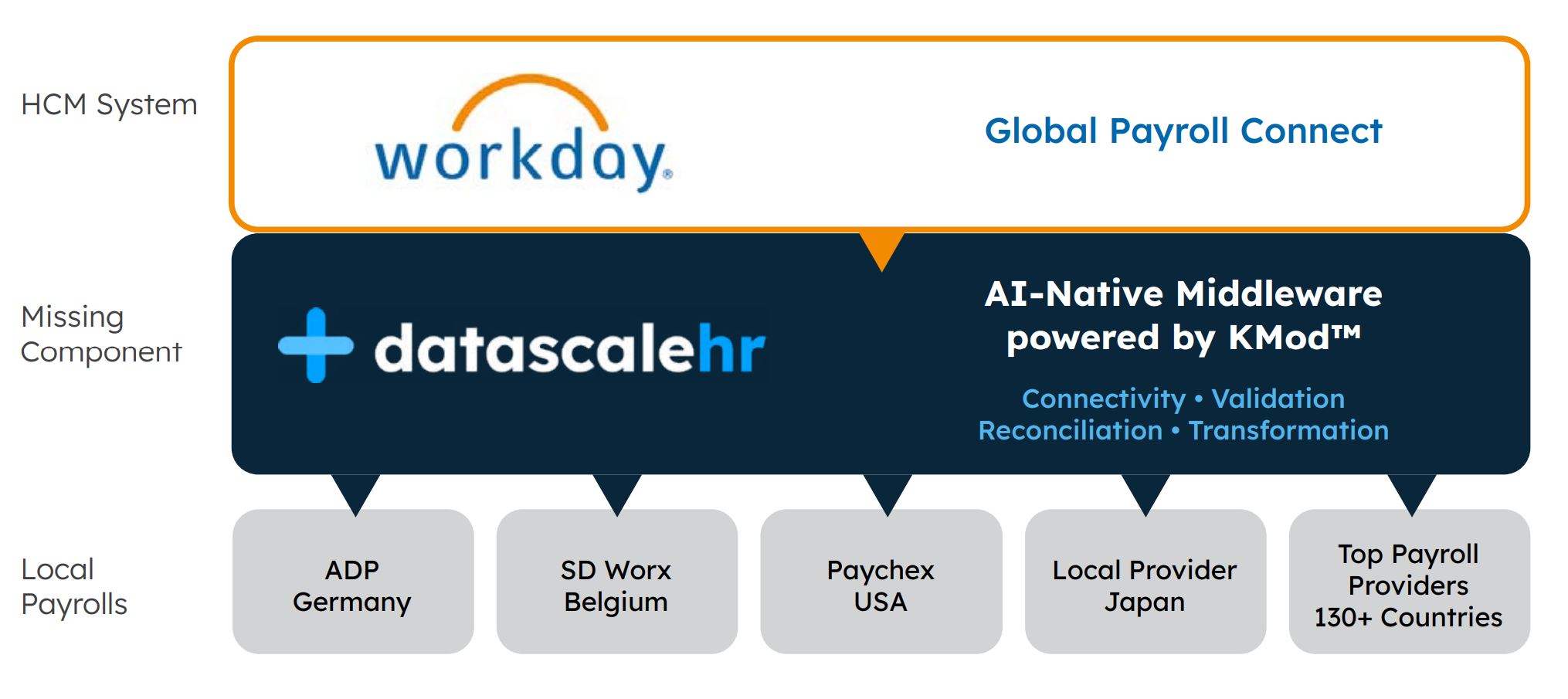
You keep your existing local payroll providers. You keep the GPC licenses you’ve already purchased.
You simply add the intelligent middleware layer that connects them.
Implementation: Days, not months. Maintenance: Self-improving—KMod adapts as providers evolve.
Accuracy: Gets better over time instead of degrading.
Proven Results using datascalehr’s platform
90-98%
Reduction
Integration development time
75%
Decrease
In ongoing maintenance costs
130+
Countries
With real-time visibility to built-in reconciliation and audit trails
Future Proof
More capable with use
The opposite of traditional system integrations
that degrade
Next Steps
If you’ve purchased Workday GPC licenses and struggled to realize value, the path forward is straightforward. Don’t re-implement payroll. Don’t buy redundant overlay software. License the missing component.
For CHROs and Heads of Global Payroll: Achieve the unified global workforce visibility you were promised—without disrupting your established local payroll operations.
For CFOs: Protect your existing Workday and local payroll investments. Activate GPC value in weeks, not years.
For CIOs and IT: Eliminate redundant software purchases and custom integration projects that consume budget indefinitely.