EU Pay Transparency Directive | June 2026
The Hardest Part of Pay Transparency Reporting Is Already Solved.
How to get your global compensation data consolidated, normalized, and audit-ready—in days
Executive Summary
The EU Pay Transparency Directive (2023/970) takes effect June 2026. Most multinationals will engage expert partners—Mercer, WTW, Korn Ferry—to help with pay equity analysis, reporting frameworks, and remediation strategies. These firms are excellent at what they do.
But every engagement starts the same way: “Give us your data.”
And that’s where the problem emerges. According to Aon’s 2025 Global Pay Transparency Study—surveying over 1,400 organizations across 40+ countries—only 19% of organizations globally consider themselves ready for pay transparency. In EMEA, 26% report they are “not ready.” Only 26% have conducted a pay equity analysis in the past 12–18 months. The unadjusted gender pay gap in the EU stands at 12% (Eurostat, 2023) and has narrowed only 4 percentage points over the past decade (from 16% in 2013).
Your advisory partners can run the analysis. They can interpret the regulations. They can build your reporting frameworks. What they can’t do is consolidate your data for you. Your employee demographics live in one HRIS. Or maybe two—plus local systems of record across different countries. Your actual payroll data is managed by one provider in one region, a different provider in another, a local solution in Germany, and niche providers everywhere else. Each system exports differently. Each defines compensation components differently. None of them talk to each other.
The critical insight
Consultants provide the analysis, but the Directive demands auditability. If you can’t prove how you reached your numbers, the burden of proof shifts to you in court. You don’t just need a report—you need a defensible, continuous data foundation. datascalehr was purpose-built for exactly this.
Sources: Aon 2025 Global Pay Transparency Study (1,400+ organizations, 40+ countries, July 2025); European Commission / Eurostat gender pay gap data, 2023.

Why the Directive Creates a Data Trap
Deep-diving into the EU Pay Transparency Directive reveals that this isn’t just a reporting exercise—it’s a continuous operational mandate. Five specific requirements create a trap for companies relying on manual processes or static consultant reports:
1.
The 5% Trigger and Mandatory Joint Pay Assessments
If pay reporting reveals a gap of 5% or more in any category of workers that cannot be justified by objective, gender-neutral criteria, the employer must conduct a Joint Pay Assessment in cooperation with worker representatives. This is public and mandatory.

The datascalehr advantage: Most companies only discover a 5% gap after the consultant finishes the annual report—at which point it’s too late to remediate quietly. datascalehr provides continuous monitoring, giving HR teams a smoke detector to close gaps before the reporting deadline triggers a mandatory (and public) joint assessment.
2.
The Single Source Principle (Article 3)
A critical but often overlooked requirement: if a central body (like Global HQ) determines pay conditions for multiple subsidiaries, those employees can be compared across different legal entities for equal pay claims.
The datascalehr advantage: Traditional systems treat each legal entity as a silo. datascalehr consolidates these into a single view, allowing Global HQ to see cross-entity risks that would otherwise remain hidden until a legal discovery process reveals them.
3.
Individual Right to Request (60-Day Deadline)
Any employee can request information on their individual pay level and the average pay levels, broken down by sex, for workers performing the same work or work of equal value. Employers must respond within two months.
The datascalehr advantage: Fulfilling a request for “average pay for similar roles in Germany” requires pulling data from local payroll, normalizing it with your HRIS demographics, and calculating the average. Doing this manually for every request is an administrative burden that grows with headcount. datascalehr makes this on-demand data accessible instantly.
4.
Burden of Proof Shift (Article 18)
Perhaps the most consequential provision: if an employer has not complied with their transparency obligations, the burden of proof shifts to the employer to prove there was no discrimination.
The datascalehr advantage: Compliance isn’t just about the final number—it’s about proving the process was objective. datascalehr provides a permanent, auditable trail of how pay data was reconciled and normalized, protecting the company from “procedural non-compliance” that would otherwise strip them of their legal defense.
5.
Granular Variable Pay Reporting
The Directive specifically demands a breakdown of “complementary or variable components”—bonuses, allowances, benefits-in-kind.
The datascalehr advantage: Base salary is relatively straightforward to track. Variable pay— overtime in France, car allowances in Belgium, 13th-month pay in Italy, mandatory profit-sharing (participation and intéressement) in France—is where the data breaks. A typical German SAP payroll runs hundreds of distinct wage types across earnings, deductions, and statutory contributions. KMod™ was designed specifically to handle these fragmented pay components that consultants typically spend weeks manually cleaning in spreadsheets.
Audit-Ready vs. Analysis-Only
The question isn’t whether you can produce a pay equity report. Any consultant can help with that. The question is whether your data foundation supports continuous monitoring, on-demand employee requests, cross-entity visibility, auditable process documentation, and variable pay normalization that doesn’t require manual work each cycle. Consultants provide analysis. The Directive demands auditability.
What Options do you Have?
Faced with the data challenge, organizations typically consider three approaches:
Option 1: Manual Data Collection and Spreadsheets
Benefits:
- No new software required.
- Uses existing HR team resources.
- Familiar process for one-off exercises.
Downsides:
- Takes 6–12 months per reporting cycle.
- Error-prone across 20+ countries.
- Non-repeatable: restart from scratch each period.
- Doesn’t scale as reporting frequency increases.
- No audit trail for burden-of-proof defense.
Option 2: Buy Dedicated Pay Transparency Software
Benefits:
- Purpose-built analytics and reporting.
- Regulatory templates for EU jurisdictions.
- Audit trails and compliance workflows.
Downsides:
- Still requires you to consolidate and clean your data first—the same underlying problem.
- Single-purpose tool: doesn’t help with payroll ops, GL, or reconciliation.
- Another vendor and system to manage.
Option 3: Solve the Data Problem First with datascalehr
Benefits:
- Connects all HR and payroll SORs.
- AI-driven normalization and first-pass analysis in days.
- Gives your consultants clean data on day one—not month three.
- If you license dedicated pay equity software, your data is ready to use on day one.
- Turns a one-off project into permanent, audit-ready infrastructure.
- Same platform powers payroll control, GL, reconciliation, and more.
Downsides:
- Willingness to invest in software licenses instead of ongoing consulting and operational costs.
Option 3 is the only approach that solves the data consolidation problem, enables your consultants to do the analytical work, and creates a permanent context layer—data infrastructure that serves pay transparency today and every AI-driven HCM use case tomorrow.
The Solution
Build the Last Mile, Then Let Your Experts Do the Rest
datascalehr doesn’t replace your compensation consultants. It gives them what they’ve always needed: clean, consolidated, normalized compensation data from every country where you operate—delivered in days rather than months—with a complete audit trail proving how every data point was reconciled.
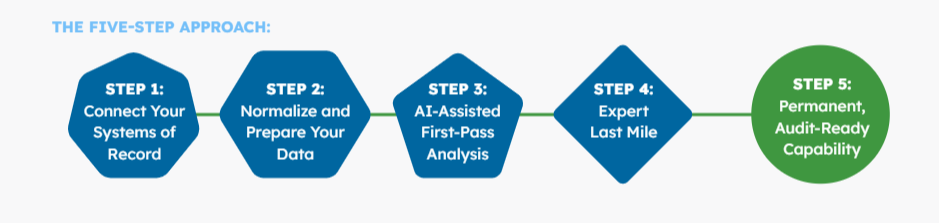
Step 1: Connect Your Systems of Record
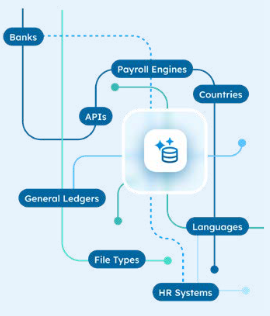
datascalehr connects to all your HR and payroll systems—whether that’s Workday (with native GPC/DCOD connectivity), SAP SuccessFactors, or any combination of global and local payroll providers, even CSV and PDF exports. Our AI-native middleware ingests data regardless of format, structure, or language. No custom development. You keep your existing systems.
Step 2: Normalize and Prepare Your Data
Our proprietary KMod™ AI understands payroll data semantics. It normalizes compensation components across countries—mapping base salary, bonuses, allowances, statutory contributions, and variable pay into consistent, comparable categories. It preserves country-specific nuances (lossless translation) while creating the unified view required for cross-border analysis.
Step 3: AI-Assisted First-Pass Analysis
With your data consolidated and normalized, even simple analysis with widely available AI tools on your spreadsheets can run a first-pass analysis on the clean dataset: identifying potential pay gaps by worker category, flagging anomalies, and highlighting areas that may exceed the 5% threshold. This focuses your consultants’ time on judgment calls, not data assembly.
Step 4: Expert Last Mile
Your compensation consultants—Mercer, WTW, Aon, Syndio, or your internal team—receive clean, categorized data ready for statistical analysis, job evaluation, and remediation planning. They do what they do best. No more months lost to data requests and reconciliation.
Step 5: Permanent, Audit-Ready Capability
Instead of a one-off project that must be repeated from scratch every reporting period, you now have a permanent data pipeline. Month-by-month monitoring. Proactive gap detection. On-demand employee information requests fulfilled in minutes. A complete audit trail that proves your process was objective if the burden of proof shifts. The Directive requires ongoing compliance—your infrastructure should too.
And as AI agents become standard tools in HR and finance, you already have the normalized, jurisdiction-aware data surface they need to operate reliably—without rebuilding from scratch.
Implementation in Hours.
Not Months.
You keep your existing systems. You keep your advisory relationships. You simply add the connectivity layer that makes both effective.
Beyond Compliance: The Data Dividend
Pay transparency compliance is the immediate mandate. But what you’re actually building is a normalized context layer for your global HCM data—a permanent, learning data surface that any application, analytics tool, or AI agent can build on. Once your HR and payroll systems of record are connected and normalized, the same data powers: Payroll Control Dashboard, Payroll Reconciliation, Workforce Analytics, GL Integration, Payroll Leakage Detection, and M&A Readiness.
Payroll Control Dashboard
Real-time visibility into global payroll spend, variances, and anomalies.
GL Integration
Automated general ledger postings from payroll data—eliminating manual journal entries.
Payroll Reconciliation
Automated cross-system reconciliation that catches discrepancies before they become costly,
Payroll Leakage Detection
AI-driven identification of overpayments, duplicate entries, and compliance gaps,
Workforce Analytics
Headcount, labor cost, attrition, and planning from a single source—no conflicting reports.
M&A Readiness
Acquire a company and integrate their payroll data in days. Day-1 payroll for new entities.
The compliance exercise becomes the catalyst for a broader transformation. Instead of paying for data consolidation once for pay transparency and again for each subsequent use case, you invest once in the context layer and derive value across every HR and finance function.
Proven Results using datascalehr’s platform
Hours
Not Months
Data consolidation that typically takes 6–12 months is compressed to hours or days. Your consultants receive clean, normalized data on day one—not month three.
90%
Automated
Our AI engine, KMod™, does 90% of the work. It has learned from 1.4 million validated mappings across 129 countries and 6,758 source and target schemas. The more it processes, the smarter it gets.
Zero
IT Dependency
Payroll specialists and HR professionals build connectors themselves—no engineering bottleneck, no IT backlog, no months waiting for developer resources. Domain experts handle what they know best.
Next Steps
Your advisory partners are ready. Your systems hold the data. The only missing piece is the last mile that connects them.
For CHROs and Heads of Total Rewards: Get your compensation data consolidated and analysis-ready before your consultants engage—cutting months off your compliance timeline.
For CFOs: Invest once in data infrastructure that serves pay transparency, payroll control, GL integration, and workforce analytics—not four separate projects.
For CIOs and IT: Eliminate manual data extracts and reconciliation spreadsheets. datascalehr connects your systems and delivers clean data automatically.
For General Counsel: Proactive, month-by-month monitoring with a complete audit trail means no surprises when reporting deadlines arrive—and a defensible process if burden of proof shifts.